Sino AI: How a healthtech startup wants to move from treating diseases to early detection
Prepared by
Digital Pool

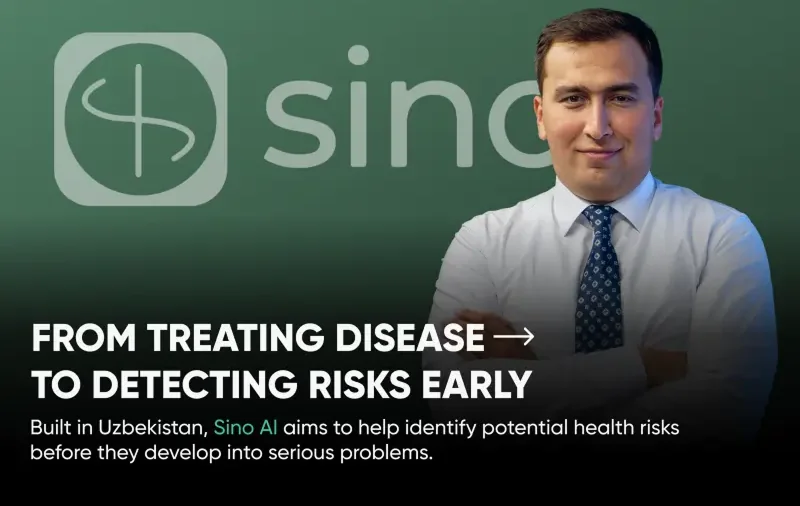
Many chronic diseases start developing long before a person notices the first serious symptoms. Sino AI wants to change this approach: the platform brings together symptoms, medical history, lab results, and everyday health data to build a personalized health profile and identify potential risks ear
“The hardest question was always the same: how serious is it, and what should we do now?”
The idea for Sino AI came from a problem familiar to many families. When someone close to you gets sick, it is not always clear how serious their condition is, whether they need to see a doctor urgently, or what the right next step should be. The founder of Sino AI experienced this personally when his parents, spouse, child, and other family members became ill. That question gradually led to the idea of building a product that could do more than respond to an existing health problem — it could also help identify changes in a person’s health earlier. The team’s bigger mission is to help people understand potential health risks before it is too late.
“We want to move healthcare from a reactive model to a preventive one”
Sino AI builds a personalized health profile by bringing together symptoms, medical history, laboratory results, and everyday health data in one place. For continuous monitoring, the team is developing the Sino Band. But the platform is not limited to its own device. The company also plans to integrate WHOOP, Fitbit, Apple Watch, and other compatible wearable devices into the system. This will allow the AI to analyze health data over time and better understand the changes happening to each individual user.
“Our main asset is not the device, but the AI health assistant”
There are already strong international products in the market. WHOOP and Fitbit focus on collecting data through wearable devices, while K Health is developing clinical AI solutions. Sino AI wants to bring several functions together in one ecosystem: health monitoring, AI-powered risk analysis, explanations of laboratory and diagnostic results, and the ability to book a doctor’s appointment. At the same time, the team does not see its own band as the main product. The core value of Sino AI is its AI assistant, which can work with different types of medical data and become increasingly personalized as it learns more about the user.
“In healthtech, being reliable is more important than being first”
For technology startups, speed is often one of the biggest advantages. But healthcare works differently.According to the Sino AI team, launching quickly cannot be more important than medical responsibility.A product that works with people’s health needs to be not only innovative, but also scientifically grounded, clinically validated, and safe.The long-term goal is to build a platform that users can trust every day and that clinics, insurance companies, and corporations will want to integrate into their own systems.
“In the long run, trust wins over speed.”
“If I could do something differently, I would have started going global earlier”
One of the team’s biggest lessons is that an international strategy should be built into the product from the very beginning.If the founder could go back in time, he would start preparing Sino AI for the global market much earlier.The company’s first target markets are Central Asia and the Caucasus. In later stages, the team plans to expand into MENA and other emerging markets.
According to the team, the total addressable market they are targeting is around $43 billion.
“For us, it is not just about the number of users, but the real value we create for their health”Sino AI does not want to measure growth only by registrations or the number of users.
For the team, what matters much more is whether the product actually helps people make the right decision at the right time.For example, if the system identifies an elevated health risk, does the user then seek medical attention? Do they complete the recommended diagnostic tests? Do they receive the medical care they need?This entire chain is one of the key indicators for the team. Of course, like any technology business, retention, subscription growth, CAC, and LTV also matter to Sino AI.But in healthtech, the team believes there is an even more important metric:
“How many people have we helped identify a health problem in time, rather than too late?”
“Uzbek startups are starting to gain international recognition”
According to the founder of Sino AI, Uzbekistan’s startup ecosystem is now going through an important stage of growth.
A few years ago, technology entrepreneurship was still a relatively niche area. Today, more young founders are thinking about global products, international accelerators, investment, and entering foreign markets.The founder believes this is being supported by the development of IT Park, local venture funds, accelerator programs, and international initiativesAnother important signal is the growing international recognition of products built in Uzbekistan.In 2026, Sino AI received the AI in Healthcare Award at the ASOCIO Digital & AI Awards.For the team, the award is not only an achievement for one startup. It is also a sign that AI and healthtech products built in Uzbekistan can compete on the international stage.
“We need not just new startups, but global companies”
According to the founder of Sino AI, the next stage for the ecosystem is to see companies from Uzbekistan become visible players in global markets. These could be products in AI, fintech, healthtech, deeptech, and other technology sectors.Sino AI wants to prove this possibility through its own journey: technology built in Uzbekistan does not have to remain focused on solving a local problem. It can scale globally and make a meaningful impact on the lives of millions of people around the world.
 Education & Healthcare